On 22 June 2026 we spent a working morning at the Regional Chamber of Commerce in Novi Sad, explaining what the eFTI Regulation and the electronic consignment note mean for companies that cross the EU border every day. Two things we said that day have already changed.
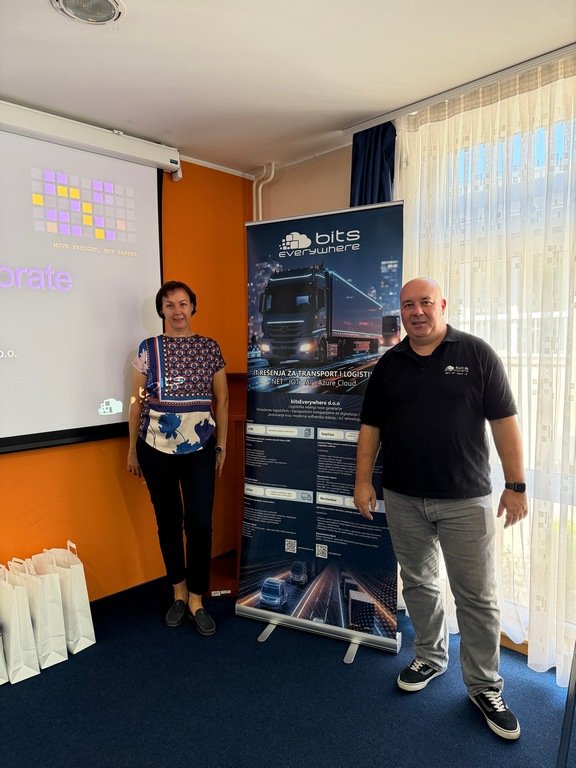
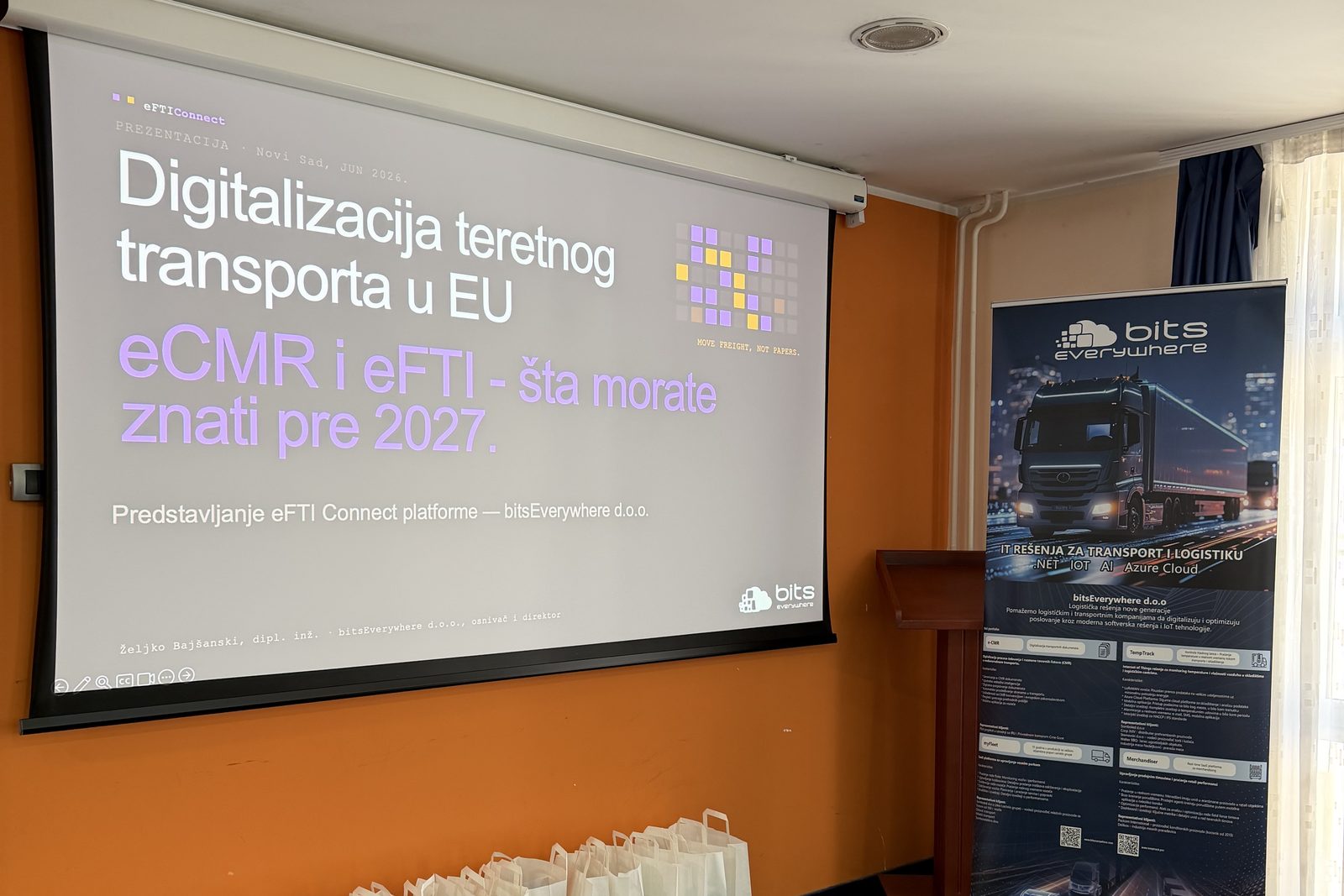
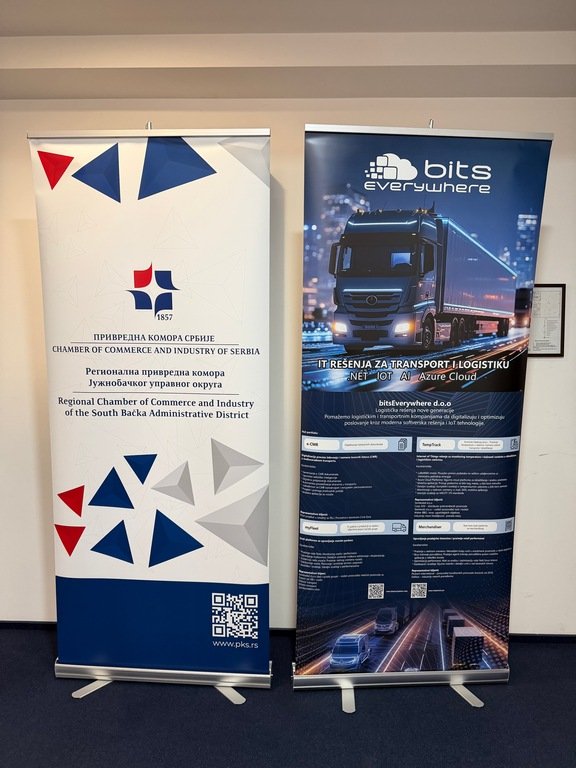
On 22 June 2026 we presented eFTI Connect at the Regional Chamber of Commerce and Industry of the South Bačka Administrative District in Novi Sad. The room held carriers, forwarders and exporters — people who put a paper CMR into a driver's hand most days of the week.
The project was introduced by Prof. Dr Pavle Gladović, who taught Željko transport technology at university. Being introduced by your own professor, in your own city, to an audience that does this work for a living, is a specific kind of pressure. I opened the session; Željko took the rest of it.
Why a chamber hall and not a webinar
Because the questions that matter here are not about software.
A carrier in Novi Sad does not need to be told that a document can be electronic. They need to know whether the inspector at Röszke will accept it, whether their German client's system can read it, and what happens to the invoice if the signed consignment note does not come back by post. Those questions get asked properly in a room, out loud, with someone else nodding in the third row — not in a chat box.
What we actually said
The talk ran about an hour before the demo, and it came down to a handful of things.
Two dates. Since January 2026, eFTI platforms may operate and member states may begin accepting electronic data at inspections. The date that matters is 9 July 2027: from that day every EU member state must accept freight transport information shared electronically through a certified eFTI platform. That is Regulation (EU) 2020/1056, in force since August 2024.
The obligation is not where people assume. Legally, the duty falls on the authorities — customs, transport inspectorates, police — to accept electronic data. For a company, using an eFTI platform is optional. In practice that distinction lasts about as long as it takes your largest EU customer to ask for electronic exchange. Your competitors digitise, inspections go faster for those who have, and the choice makes itself. Legally optional, economically inevitable.
Some countries are not waiting for 2027. Spain's DCA — Documento de Control Administrativo, the administrative control document that accompanies road freight — has to be digital only from 5 October 2026, with penalties of up to €1,000 per breach, and it applies to any transport entering, leaving, crossing or operating inside Spain regardless of where the company is based. Spain is first, others will follow, and none of them are waiting for the common EU framework — which means a platform has to serve several regulations at once, not just the EU minimum.
The legal ground under the eCMR. The CMR Convention dates from 1956 and everybody in that room has handled the paper version. The Additional Protocol of 2008, in force since 2011, gives the electronic consignment note the same legal force as the paper one — but only between countries that have ratified it. At the time of the talk, 41 states were party to it (UN treaty records, May 2026), including Hungary, Slovenia, Austria, Germany and Italy, with North Macedonia and Albania joining in April 2026. Serbia had not ratified. Željko said so plainly, because this is the detail our industry most often blurs.
What carriers gain. Faster border crossings — a QR code instead of a folder. Fewer errors, because structured data is validated as it is typed. Lower cost: no printing, no couriers, no ten years of paper archive. And the one that lands hardest in a room of business owners: faster payment. The invoice waits on the signed consignment note coming back from Germany or Italy by post. With an eCMR, the moment the driver unloads and the consignee signs, the document is in the system and the invoice goes out.
And the hard parts, because a sales pitch that skips them is not worth an hour of anyone's morning. Interoperability is the real technical problem — "one of the key challenges limiting the use of eCMR is precisely the lack of interoperability between the different actors in the process," as Raluca Marian of the IRU's EU delegation put it in 2023. Certification is slow and expensive, so there will be a dozen or two surviving platforms, not thousands. And the deepest problem is not software at all: inspectors need equipment and training, drivers need a tool that does not ask them to be IT specialists, and habits change slower than regulations do.
Then we showed the platform live: creating an eCMR as a forwarder, the driver's mobile app, signing at the loading point, an inspector verifying by QR code, and the dashboard behind it.
Two things we said that morning are already out of date
Both in the right direction.
Serbia has ratified the 2008 Additional Protocol. The slide that read "not yet ratified" was accurate on 22 June and was overtaken within weeks. The electronic consignment note is now legally equivalent to paper on international routes where the other country has ratified it too — which, for our customers' most-driven corridors, is most of them.
We joined the Open Logistics Foundation. On 9 July 2026 the Foundation that maintains the open eCMR standard announced bitsEverywhere as its first member company from Serbia. On 22 June we could say we build on their open standard and use their eSeal signer; since July we work inside the standard's own working groups. We wrote about what that does and does not mean — it is not a certification, and we will not present it as one.
What we are offering the people who were in that room
The same thing we said from the podium, unchanged.
A free assessment: we come to you, watch how your documents actually move, and write a plan against your operation rather than our product catalogue. Then a pilot on one route, with one client — if it works we scale it, and if it does not, we have both learned something for the price of a few weeks. And integration rather than replacement: your ERP, TMS or warehouse system stays where it is, and the transport documents get an electronic layer over a REST API.
Thank you to the Regional Chamber for the hall and the audience, to Prof. Gladović for the introduction, and to everyone who stayed behind afterwards to ask the questions they did not want to ask into a microphone.
Companies that start in 2026 will meet 9 July 2027 comfortably. The ones that start in 2027 will meet it at the same time as their competitors, and at the same border.
Move freight, not papers.


